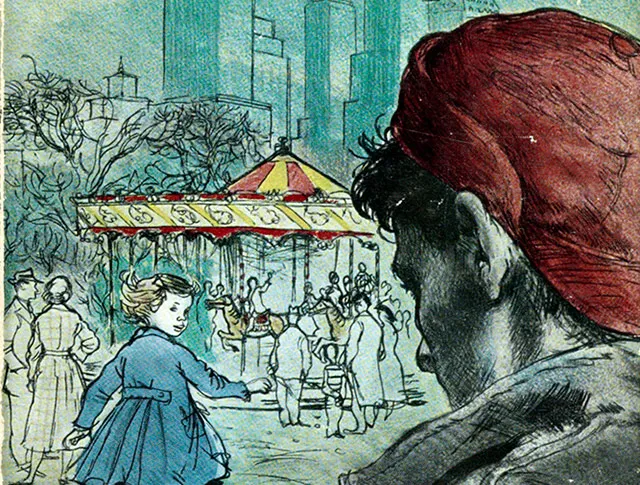
Since I first read this book in high school, it’s been my absolute favorite. At this point, I’ve read it about six times. And it never gets old. Even though it’s considered a “classic” in the literary world, it’s relatively easy to read and understand. The writing isn’t dated at all. And I also love the amount of profanity this book includes. The number of times Holden refers to someone as a “bastard” is gold. I think it also makes the book much more enjoyable, and lightens it up to balance out some of the darker themes.
But anyway, in light of this being my favorite book of all time and the fact that I’m currently rereading it, I decided to write an in-depth book review to share here. I’m going to first give a little synopsis, discuss common themes, share my favorite quotes, and my final thoughts. So here it is:
Synopsis
The Catcher in the Rye is a novel by J.D. Salinger, published in 1951. It follows the story of a 16-year-old boy suffering from depression who was recently expelled from Pencey Prep. Holden, the main character, is sharing this narrative from a psychiatric facility, as he’s recovering from the breakdown he recounts throughout the book.
Chapters 1-6
The timeline occurs over two days, beginning on his last day at Pencey Prep after the fall semester ends. The story begins with him going to tell his old history teacher, Mr. Spencer, goodbye. Mr. Spencer tries to lecture Holden on applying himself more in school for the sake of his future. Holden doesn’t really give two shits to hear any of it and makes an excuse as to why he needs to get going.
He then goes on to tell about his interactions with Ackley and his roommate, Stradlater, back in his dorm room. Stradlater is going out with a longtime friend of Holden’s that evening, and since Holden doesn’t have a date that night, Stradlater asks him to write his composition paper for him. Holden decides to write the essay on his deceased brother’s old baseball mitt.
After Stradlater returns from his date, he looks over the composition Holden wrote for him, but is frustrated and says it didn’t have anything to do with the assignment. Holden tears it up and throws it away. The tension between the two rises when Holden asks about his date with Jane. Stradlater refuses to give details, which makes Holden so angry that he attacks him. Stradlater, a much bigger guy, pins Holden on the floor until he can calm down. After he lets him up, Holden just keeps insulting him until finally Stradlater has had enough and just punches him right in the face.
Chapters 7-12
After the fight, feeling lonely and desperate, Holden goes over to Ackey’s room to shoot the shit with him. Ackley, trying to sleep and all, wasn’t great company. All Holden could think about was Stradlater and Jane’s date and why he wouldn’t give him any details about it. It drove Holden crazy. Feeling depressed and lonesome, Holden decides on a whim that he’s just gonna get the hell out of Pencey a few days early. He wants to go back to New York, take it easy at a cheap hotel, and go back home on Wednesday after his parents learn about his expulsion.
On the train to New York City, he meets the mother of a boy in his class and shoots the shit with her for a while. He then takes a cab to the Edmont Hotel, where he plans to lie low until Christmas break begins. He goes on to tell about his experience at the Lavender Room (the hotel bar), where he meets some girls and dances with them (although he claims they’re all morons).
After leaving the Lavender Room, Holden still isn’t tired, so he goes to a nightclub called Ernie’s. Here he runs into a girl who used to date his older brother D.B. Let’s just say he’s not crazy about her. She invites him to sit with her and her date, but Holden says he has to get going and therefore is forced to leave the bar.
Chapters 13-17
Holden doesn’t want to take a cab back to his hotel and instead walks the whole 41 blocks. Once he makes it back to his hotel and gets on the elevator, he’s offered a prostitute. Being “so depressed he can’t think straight”, he accepts one for the hour. The problem is, though, once she’s sent up to his room, he’s not really in the mood for that sort of thing. He asks the girl if she just wants to talk instead, and he’d still pay her, but she’s a lousy conversationalist and she ends up leaving instead.
Right around the time the sun started to come up, the prostitute and elevator operator came up to Holden’s room, claiming he didn’t pay the full price for his service. Holden, having paid, claimed he did and that they were trying to crook him. The altercation ends with Holden being punched square in the stomach. After lying on the floor for a while, he finally decides to go to sleep.
After he wakes up, he decides to call Sally Hayes and meet her for a movie later that afternoon. He goes to a diner beforehand for breakfast, where he meets some nuns. He talks with them for a while about school, literature, and other stuff. To kill time before his date with Sally, he wanders around Central Park because he thinks his kid sister Phoebe may be there roller-skating, and he wants to give her a record he bought for her. Not being able to find her, he takes a cab to where he plans to meet Sally. They go see a play and go ice-skating afterwards. However, the date doesn’t go well and ends with Sally crying and them going their separate ways.
Chapters 18-24
Holden still needs to kill time until he can go home on Wednesday. He decides to catch another movie at Radio Hall and meet an old friend for a drink afterwards. He stays at the bar a while, and by the time he leaves, he’s so stinking drunk he just wanders around Central Park before he decides to walk back home and talk to his kid sister Phoebe. Once he gets up to his family’s apartment, he visits with Phoebe; however, she’s mad at him once she discovers he’s been kicked out of yet another school.
While at home, Holden decides to call up Mr. Antolini, an English teacher he had at Elkton Hills. After spending some more time with Phoebe, his parents come home, so he goes to stay the night at Mr. Antolini’s place.
Once he’s there, they talk for a while about school and Holden’s future. Mr. Antolini expresses his concern for him and also emphasizes how important education is for his future. And although right now, he’s on the brink of fallout, other people have been in his shoes and have come out on the other side. While it was a good conversation, Holden hadn’t slept in ages, so he finally fell asleep on the couch. However, he wakes up in the middle of the night to Mr. Antolini stroking his hair. Holden is very embarrassed about the situation and decides to leave, saying he needs to get his bags from Grand Central Station.
Chapters 25 & 26

He sleeps the rest of the night at Grand Central Station, but when he wakes up, he can’t stop thinking about the weird encounter with Mr. Antolini. Finally, he decides he’s gonna run away out west and live in a cabin near the woods. He wants to say goodbye to Phoebe first, so he has a note delivered to her at school saying to meet at the museum for lunch. She arrives with a packed bag because she wants to go with him. He says she can’t, which makes her upset. Instead, they go to the zoo, and he takes her to ride the carousel in the pouring rain.
He decides he isn’t gonna go away anymore. He’s just gonna go home. The flashback ends with Holden explaining that he got sick, he’s currently in a psychiatric facility, but he’s going back to school in the fall. The book ends with him sorta reflecting on all the people he’d met with on this two-day crash out. He says, “About all I know is, I sort of miss everybody I told about. It’s funny. Don’t ever tell anybody anything. If you do, you start missing everybody.”
Themes
Loss of Innocence and Growing Up
The main theme in The Catcher in the Rye is the loss of innocence and fear of growing up. Holden idealizes the innocence of childhood and fears the corruption and superficiality of adulthood. He mentions his fantasy of being the “catcher in the rye” several times throughout the book, which symbolizes his desire to protect children from this fall.
Another thing mentioned frequently throughout the book is the ducks that live near the lagoon in Central Park. He says, “I was wondering where the ducks went when the lagoon got all icy and frozen over.” He asks several people where the ducks go in the wintertime when the lagoon freezes. This is a metaphor for growing up and Holden’s fear of change and the unknowns of entering adulthood. This repeated quote suggests his anxiety about leaving the familiar comfort of childhood and having to face the difficult realities of becoming an adult. We can see throughout the book that Holden struggles to navigate and understand this transition into adulthood and the maturity that must come along with it.
Alienation and Loneliness
Throughout the story, we can see that Holden feels disconnected from the people and institutions around him. While he longs for meaningful connection in his life and actively seeks out interaction throughout the story, he typically ends up feeling depressed, alienated, and isolated from the world around him.
Grief and Trauma
The death of Holden’s little brother, Allie, is a significant cause of grief and trauma for Holden. We can see throughout the story that this has affected him deeply and is a source of his ongoing emotional pain that also influences his overall worldview.
Phoniness and Hypocrisy
Throughout the book, Holden is consistently critical of the lack of authenticity in the people around him. During Holden’s narration of this story, he labels others and their behaviors as phony, pretentious, and hypocritical. He believes that materialism, status, and conformity to societal norms drive the way people act and behave in adulthood. He specifically refers to Mr. Haas (Pencey’s headmaster), Sally Hayes, and Stradlater as being insincere and phony.
Depression
Holden obviously suffered from depression. He’s telling the narrative from a psych facility and often says lines throughout the book referring to his mental state. He says things such as “I’m in bad shape. I’m in lousy shape” and “I think I was more depressed than I ever was in my whole life,” as well as making several references to suicide. At the end of the story, he mentions that he fell sick, referring to his mental illness, which led to his admission to a psychiatric institution.
Favorite Quotes
“I don’t care if it’s a sad goodbye or bad goodbye, but when I leave a place I like to know I’m leaving it. If you don’t, you feel even worse.”
“What really knocks me out is a book that, when you’re all done reading it, you wish the author who wrote it was a terrific friend of yours and you could call him up on the phone whenever you felt like it.”
“In every school I’ve gone to, all the athletic bastards stick together.”
“All morons hate it when you call them a moron.”
“I really felt like dancing. I’m very fond of dancing.”
“Listen,” he said. “If you was a fish, Mother Nature’d take care of you, wouldn’t she? Right? You don’t think them fish just die when it gets to be winter, do ya?”
“I’m always saying “Glad to’ve met you” to somebody I’m not at all glad I met. If you want to stay alive, you have to say that stuff, though.”
“The best thing, though, in that museum was that everything always stayed right where it was.”
“Certain things they should stay the way they are. You ought to be able to stick them in one of those big glass cases and just leave them alone.”
“You figured most of them would probably marry dopey guys. Guys that always talk about how many miles they get to a gallon in their goddam cars. Guys that get sore and childish as hell if you beat them at golf, or even just some stupid game like ping-pong. Guys that are very mean. Guys that never read books. Guys that are very boring-But I have to be careful about that. I mean about calling certain guys bores. I don’t understand boring guys. I really don’t.”
“Did you ever get fed up?” I said. “I mean did you ever get scared that everything was going to go lousy unless you did something?”
“You ought to go to a boys school sometime. Try it sometime,” I said. “It’s full of phonies, and all you do is study so that you can learn enough to be smart enough to be able to buy a goddam Cadillac some day, and you have to keep making believe you give a damn if the football team loses, and all you do is talk about girls and liquor and sex all day, and everybody sticks together in these dirty little goddam cliques. The guys that are on the basketball team stick together, the Catholics stick together, the goddam intellectuals stick together, the guys that play bridge stick together. Even the guys that belong to the goddam Book-of-the-Month Club stick together.”
“You can’t teach somebody how to really dance.”
“The mark of the immature man is that he wants to die nobly for a cause, while the mark of the mature man is that he wants to live humbly for one.”
“I think that one of these days you’re going to have to find out where you want to go. And then you’ve got to start going there.”
“You’ll find that you’re not the first person who was ever confused and frightened and even sickened by human behavior.”
“Many, many men have been just as troubled morally and spiritually as you are right now. Happily, some of them kept records of their troubles. You’ll learn from them-if you want to. Just as someday, if you have something to offer, someone will learn something from you. It’s a beautiful reciprocal arrangement. And it isn’t education. It’s history. It’s poetry.”
“I’m not trying to tell you,” he said, “that only educated and scholarly men are able to contribute something valuable to the world. It’s not so. But I do say that educated and scholarly men, if they’re brilliant and creative to begin with-which, unfortunately, is rarely the case-tend to leave infinitely more valuable records behind them than men do who are merely brilliant and creative. They tend to express themselves more clearly, and they usually have a passion for following their thoughts through to the end. And-most important-nine times out of ten they have more humility than the unscholarly thinker”.
“The thing with kids is, if they want to grab for the gold ring, you have to let them do it, and not say anything. If they fall off, they fall off, but it’s bad if you say anything to them.”
Final Thoughts
Overall, I’d rate this book a solid 10/10. It’s been my favorite book since high school (the last 7 years), and I feel like it always will be.
Holden’s narration is so easy to follow and understand, and the themes of the book are very touching. While very serious, real, and dark themes are explored, the heart of the story remains slightly humorous. And I think that’s important for any book, yet also incredibly difficult to pull off. So props to J.D. Salinger. I can’t wait to read some more of his work.
I, of course, recommend reading this book at least once. It’s a classic. You may not love it, but at the very least, I bet you’ll like it.
Anyway. Thanks for reading, everyone!
This was my very first book review I’ve published, but I’m looking forward to doing some more in the future!
Until next week!